

Surviving the current housing climate as a homeowner may seem daunting considering: fluctuating interest rates, the implementation of tariffs, federal furloughs and corporate downsizing, and the administration’s recommendations to defund housing policies that impact homebuyers and homeowners.
Maintaining a home is the largest monthly expense incurred by most Americans, and a reduction in income is the primary reason borrowers become delinquent, according to Housing Counseling Services (HCS).
In the past, homeowners have been able to rely on programs like Making Homes Affordable, Homesavers, Homeowners Assistance Fund, and the Reverse Mortgage Insurance Tax Program to provide financial relief and an opportunity to keep homes, but they are no longer available.
Despite the elimination of several helpful resources, Darnell Snell, director of Housing Counseling Services Foreclosure Prevention, said there’s still hope.
“A reduction in income does not mean that you must be a victim of foreclosure,” said Snell.
The foreclosure prevention expert said often lenders can work with homeowners to help, not harm, them.
“When lenders say they do not want your house, they are actually telling the truth. Lenders would much rather work with you to help you stay in your home as they are not in the business of foreclosing properties and then being responsible for maintaining such properties,” Snell explained. “They would rather work with you to keep you in your home as keeping you in your home is more cost effective than foreclosing on your home (most times). Foreclosing on a homeowner is usually the last resort that lenders take to recuperate their investment.”
Many DMV residents are directly or indirectly connected to the federal government, and thus, especially susceptible to becoming victims of foreclosure, according to the Greater Metropolitan Association of REALTIST (GMAR).
“Our region is uniquely impacted because our economic engine–the federal government–is being gutted, leading to job losses, contract reductions, and decreased income stability for many households in the DMV,” noted Nichelle McDuffie Hagins, president of GMAR.
Other key drivers of foreclosure challenges include: inflation, the expiration of pandemic-related protections, rising insurance and property tax costs, and limited access to refinancing options.
“As of mid-2025, Maryland continues to experience elevated foreclosure activity compared to pre-pandemic levels. The state remains among the top 15 in foreclosure rates nationally, with counties like Prince George’s, Baltimore City, and parts of Montgomery County being disproportionately affected with counties like Prince George’s, Baltimore City, and parts of Montgomery County being disproportionately affected,” Hagins explained. “Many homeowners who exited forbearance programs are struggling to get current without sufficient financial or legal guidance.”
Help is On the Way: Stave off Foreclosure by Tapping Into Resources
Homeowners do not have to face the potential of foreclosure without help.
Organizations and government agencies are aware of the current landscape and offer workshops, counseling and programs to walk residents through the foreclosure process and even help to save their homes.
Greater Metropolitan Association of REALTIST (GMAR)
GMAR is hosting community events to provide residents with the resources and tools needed to make confident decisions about real estate including foreclosure. These events include access to HUD-certified housing counselors, legal support, and educational workshops focused on foreclosure prevention.
“Our goal is not just to respond to the crisis, but to equip the community with long-term strategies to preserve homeownership and build generational wealth,” said Hagins.
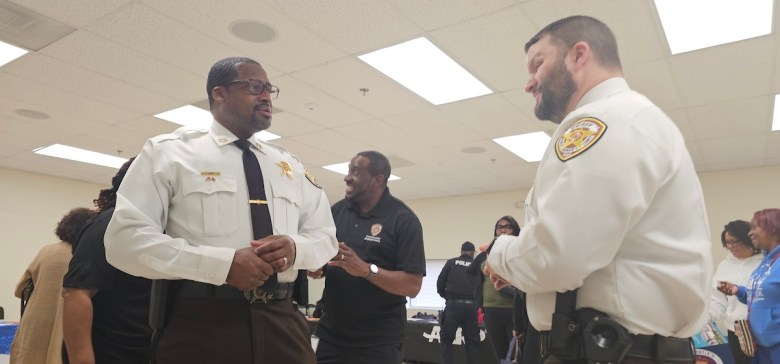
The Prince George’s County Sheriffs’ Department
While the Prince George’s County Sheriffs’ Department enforces foreclosure evictions by recovering properties and coordinates the sale of properties that have outstanding tax liens–also known as Sheriff Sales–it also offers resources to residents who are losing their home or apartment. The sheriff’s department provides a directory on its website on protections, next steps and a directory for alternate living spaces.
“We are advocates and the impartial party in reference to the [foreclosure] court
process,” said Prince George’s County Sheriff John D.B. Carr. “The reason why I
say I’m an advocate is because, even though you’re talking about recovering
property–serving a civil process– I want to make sure our citizens know ahead of
time how that process goes, so that they can either save their home, they can
have the resources that they need to get through this tough time.”
The District’s Mediation Foreclosure Program
In the District, the U.S. Marshall enforces home foreclosures. Before it comes to that, however, banks may choose to go through a judicial foreclosure process through District Superior Court or nonjudicial process through the Mediation Foreclosure program.
The homeowner, bank, and a neutral third party mediator discuss whether or not the owner qualifies for a foreclosure avoidance.
Once a homeowner receives a notice of default, they can apply to the Mediation Foreclosure program by returning the mediation election form no later than 30 days after the bank mails the notice of default.
An additional benefit of the mediation process is the foreclosure must stop until the application process and pending mediation is complete.
DCHD Community-Based Organizations
The D.C. Department of Housing and Community Development (DHCD) has a network of dedicated community-based organizations (CBOs) that offer comprehensive housing counseling to both prospective homeowners and current homeowners.
These organizations provide invaluable resources to help District residents to avoid foreclosure through foreclosure mediation, housing counseling, and legal aid for homeowners.
Housing Counseling Services provides specialized foreclosure prevention services by HUD-certified counselors to District residents, helping borrowers to recognize their options, operating the DC Foreclosure Prevention Hotline (202)265-2255, attending all judicial foreclosure hearings, assisting with mediations and providing up to three hours of legal review to eligible homeowners.
“It is important to stay in contact with your lender, don’t hide from the situation and do whatever you can (financially) to show the lender that you can maintain some sort of a financial agreement (rather it be old or new),” said Snell.
As a foreclosure prevention specialist Snell also emphasized that there are other options besides holding onto a home.
“It is also important to know that preventing foreclosure does not always mean that you can keep your home (either). If an actual foreclosure is inevitable, there are other options available to you that will allow you to simply release the home to stop the foreclosure,” Snell continued. “Releasing the home is a much better option than an actual foreclosure as the ramifications of an actual foreclosure can have long term negative effects to an individual. Releasing the home includes selling the property as well as giving the home back to the lender in exchange for forgiveness of your debt.”
To learn more about foreclosure and foreclosure laws visit lawhelp.org and legal-info.lawyers.com.
District residents can call the following numbers for foreclosure prevention assistance:
- Foreclosure Prevention Hotline: (202) 265-CALL (2255) or 1(855) 449-CALL (2255)
- DC Department of Insurance, Securities and Banking at (202) 727-8000