
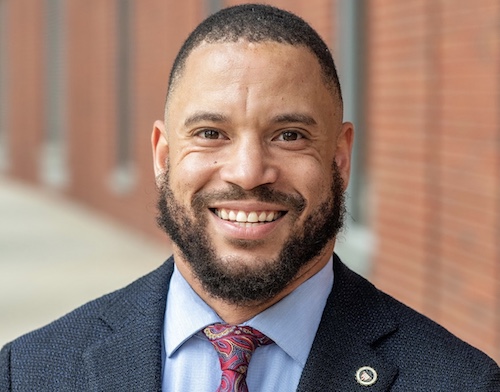
Ravi K. Perry prides himself as one who is abreast of the issues that affect his 7E06 advisory neighborhood commission located in the Marshall Heights area of Ward 7 in Southeast Washington.
However, even Perry was surprised when he found out his constituency was one of the areas in the District that is considered an urban heat island. The Environmental Protection Agency (EPA) defines heat islands as a phenomena that occurs when a developed area experiences higher temperatures than nearby rural areas, or when areas experience hotter temperatures within a city.
“To me, this is an example of environmental racism,” Perry, 42, told The Informer. “Marshall Heights obviously is not like downtown where there are no trees, but I am not necessarily surprised. There are lots of trees in the nearby Fort DuPont area. What about the Hillcrest neighborhood? This is something that needs to be studied.
“Does that mean Marshall Heights residents pay more for their utility bills than other residents in the city? Are there more health risks for Marshall Heights residents because they are on an urban health island?”
Perry voices his concerns as the summer months approach and the country focuses on the annual Earth Day recognition (April 22), which focuses on maintaining clean and safe environments.
“We need to know about the urban heat island effect in Marshall Heights and what could be done because there will be a lot of development in this area in the future,” he said “especially if the Washington Commanders build a stadium on the banks of the Anacostia River.”
The Urban Heat Island Phenomena
Urban heat islands are a nuanced issue in the District affecting many Black Washingtonians.
A March 2024 GW Law Environmental and Energy Law Blog article written by Daniel Basescu, “Heat Islands and Race in Washington, D.C.,” spells out the main issues surrounding the controversy.
“When it comes to heat, not all neighborhoods in Washington, D.C. are created equal,” Basescu said. “In denser areas of the city with less wind, less green space, and less tree cover, heat radiates and is trapped at much higher rates that vary the ambient air temperature by up to 16 degrees Fahrenheit. This phenomenon is known as the urban heat island effect.”
Basescu said the urban heat island effect is a result of the racist policies that segregated Black and other minority populations away from white populations in the city. To further illustrate the racial makeup of urban heat island phenomena, an October 2024 blog of Greater Greater Washington noted that according to the National Oceanic and Atmospheric Administration, the city’s coolest neighborhood is Colonial Village, a predominantly white neighborhood located in Ward 4 in Northwest.
Basescu also pointed out that, beyond the outcry of environmental injustice, the disparities coupled with urban heat island only further inequity across marginalized communities.
“This difference means different energy bills, emissions levels, health outcomes, and quality of life for thousands of residents,” he wrote.
Solution to Urban Heat Island Effect: Trees and Shade
Eliza Cava is the chair of the Conservation committee of the District’s chapter of the Sierra Club, a national environmental preservation organization.
Cava, who lives in the Petworth neighborhood in Ward 4 in Northwest, considers her area an urban heat island due to what she said was a lack of green space and missing one thing in abundance — trees.
“Trees are not as available as they are in Rock Creek Park,” Cava, 39, said. “We need to plant trees and protect those trees that we have. Trees provide shade and comfort. In the city, there is a lot of asphalt. We need the trees.”
D.C. Council member Charles Allen (D-Ward 6) chairs the Committee on Transportation and the Environment and is well aware of heat islands in the city. He proposed the legislation — The Solar Shade Expansion Amendment Act of 2025 – to deal with the challenges.
The measure would require the District government to identify 20 sites – ranging from playgrounds and parks, to sidewalks, bike lanes, and roads – that could benefit from solar canopies.
“Ask any parent, and they’ll tell you it’s hard to use our playgrounds for weeks on end in the summer – a little shade goes a long way,” said Allen, 48. “This is true across all our outdoor spaces for residents of all ages. We simply need to build more shade. At the same time, the more clean energy we generate with renewables right here in the District, the more money we keep in our communities.”